

Waldorf School of the Peninsula

Waldorf School of the Peninsula
The Waldorf School of the Peninsula, located in the heart of Silicon Valley, offers a distinctive educational approach rooted in the philosophy of Austrian educator Rudolf Steiner. As part of the global Waldorf Education movement, the school emphasizes holistic development, balancing academic rigor with artistic expression, social responsibility, and spiritual growth. In this detailed article, we explore the school's educational philosophy, programs, campus life, faculty, community involvement, and its role in shaping innovative, compassionate leaders of tomorrow.
A Legacy of Waldorf Education
Founded in 1984, the Waldorf School of the Peninsula (WSP) has served families from across the San Francisco Bay Area. The school is one of more than 1,000 Waldorf schools worldwide and one of around 130 in North America. Waldorf education was developed in 1919 by Rudolf Steiner, who envisioned a pedagogy that would cultivate a child’s intellectual, artistic, and practical skills in an integrated and developmentally appropriate manner. The philosophy is built around the idea that education should not only convey knowledge but also foster imagination, critical thinking, empathy, and moral integrity.
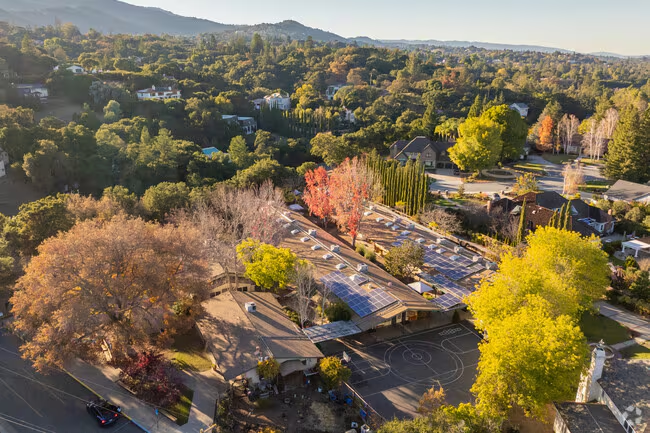
WSP offers programs from preschool through Grade 12 across its two campuses—one in Los Altos (Nursery–Grade 5) and another in Mountain View (Grades 6–12). Each stage of development is addressed with a carefully tailored curriculum that evolves with the needs of students.
Philosophy and Pedagogical Approach: Waldorf School of the Peninsula
Waldorf education emphasizes the integration of the arts, movement, and practical activities into academic instruction. Unlike traditional education models, Waldorf classrooms avoid early academic pressure, standard tests, or heavy reliance on digital technology in the early years. Instead, the approach focuses on the developmental stages of the child, ensuring that each phase of cognitive and emotional growth is honored.
In the early years, imaginative play and social development are emphasized. In elementary school, storytelling, handcrafts, music, and physical movement accompany core academics. Middle and high school bring more rigorous intellectual exploration, critical thinking, philosophical discussions, and artistic expression.
A hallmark of the Waldorf method is the use of “main lesson blocks.” Rather than juggling multiple subjects each day, students immerse themselves in one core subject over several weeks, allowing for deep, uninterrupted engagement. This structure also enables teachers to integrate art, music, and movement into each lesson.
Curriculum Overview
Early Childhood (Nursery & Kindergarten)
The focus is on play-based learning, rhythmic routines, and imitation. Children engage in activities such as baking, gardening, painting, singing, and puppet shows, which foster sensory development, language skills, and social interaction. There are no screens or formal academic instruction at this stage.
Lower School (Grades 1–5): Waldorf School of the Peninsula
The curriculum introduces reading, writing, math, and science through storytelling, art, and hands-on activities. Children create their own main lesson books, which serve as personalized textbooks. Thematic subjects such as mythology, legends, and fables are incorporated to build moral reasoning and cultural awareness.
Middle School (Grades 6–8)
Students develop greater independence and analytical skills. The curriculum includes geometry, algebra, physics, history, and chemistry. Arts and handwork continue to be integrated with subjects. Teachers emphasize the balance between head, heart, and hands.
High School (Grades 9–12): Waldorf School of the Peninsula
Academic rigor increases with college-preparatory content in sciences, humanities, and mathematics. Literature, world history, philosophy, and environmental studies are presented through seminar-style discussions. Students complete major artistic and independent research projects. High schoolers participate in internships, service learning, and may even travel for class trips.
Arts, Music, and Handwork
Creativity is not seen as an extracurricular at WSP—it is central to the learning experience. From Grade 1, students learn to play instruments such as the recorder and violin. As they progress, they can join orchestras, choirs, and jazz bands. Visual arts are integrated into all subjects, with techniques like watercolor, charcoal, and block printing taught regularly.
Handwork such as knitting, woodworking, and sewing are part of the curriculum. These crafts are not just for practical skills but also foster fine motor development, concentration, patience, and aesthetic appreciation.
Science and Technology
Though technology is limited in early grades, WSP does not shy away from STEM education. In the high school years, the science curriculum includes biology, physics, chemistry, and environmental studies. Students perform lab experiments and undertake in-depth projects. The school encourages thoughtful engagement with technology, teaching coding and engineering in ways that are balanced and human-centered.
Foreign Languages and Cultural Studies
Students begin learning Spanish and Mandarin Chinese in the elementary grades. Language instruction includes songs, games, dialogues, and cultural traditions. The exposure to different languages is part of a broader emphasis on cultural literacy and global awareness.
Athletics and Outdoor Education: Waldorf School of the Peninsula
Physical movement is essential to Waldorf education. Games, eurythmy (a form of movement developed by Steiner), hiking, and cooperative sports help build physical coordination, spatial awareness, and social skills. Older students participate in team sports, nature immersion programs, and multi-day outdoor expeditions.
Field trips, wilderness survival training, and environmental stewardship are woven into the curriculum. WSP’s setting in Northern California provides a rich environment for these activities.

Community and Student Life
The school community values collaboration, inclusion, and service. Parent involvement is considered a key part of the student’s educational journey. Seasonal festivals, music performances, art exhibits, and theater productions are community events that celebrate students’ work and promote cultural connection.
WSP offers student leadership opportunities, clubs, social events, and service projects. High school students often engage in social justice initiatives, climate action, and mentorship programs for younger peers.
Faculty and Teacher Continuity
Teachers at WSP often stay with the same class for several years, particularly in the elementary grades. This continuity builds deep student-teacher relationships and allows educators to respond more effectively to each child's needs. Faculty members undergo continuous training in Waldorf pedagogy, child development, and interdisciplinary teaching methods.
Admissions and Diversity
WSP seeks families who align with its values of holistic development, cultural appreciation, and education as a lifelong journey. The admissions process includes family interviews, student observations, and classroom visits. The school is nonsectarian and open to families of all backgrounds.
Efforts are made to ensure economic diversity through need-based tuition assistance. The school also works to diversify its faculty and curriculum to reflect a wider range of voices, perspectives, and histories.
Outcomes and Alumni: Waldorf School of the Peninsula
Waldorf School of the Peninsula alumni attend a wide range of universities and colleges, both liberal arts and STEM-focused institutions. Beyond academic success, WSP graduates are known for their adaptability, creativity, leadership, and empathy—traits that are increasingly valued in the modern world.
Alumni often pursue careers in education, technology, social entrepreneurship, the arts, medicine, and public service. Many cite their Waldorf education as instrumental in helping them think critically and live meaningfully.
Conclusion
The Waldorf School of the Peninsula stands out as an institution dedicated to nurturing the full human potential of each student. In a world increasingly dominated by standardized testing and digital overload, WSP offers a humane, thoughtful alternative. With its deep commitment to art, nature, relationships, and lifelong learning, the school not only prepares students for college and careers but also helps them become conscious, capable contributors to a more just and sustainable world. Whether it’s through handcrafts or humanities, physics or philosophy, WSP’s integrated education fosters both heart and mind—and shapes students who are not only knowledgeable but wise.
In case, if you need help with Homestay and Guardianship for students in order to study in Waldorf School of the Peninsula or other schools in the US, please fill in application below or contact us directly.